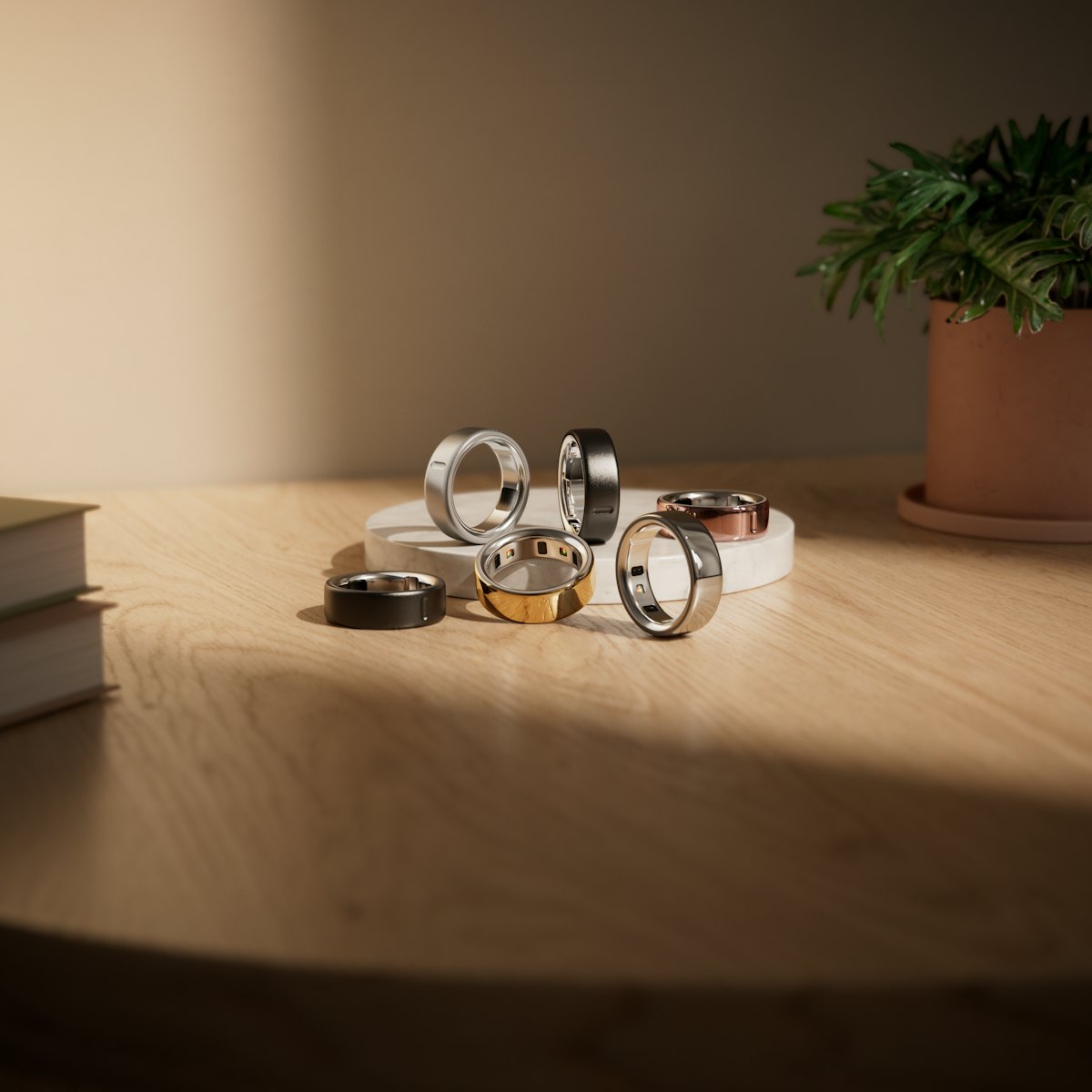
Oura Ring 4 Review 2026: The Best Sleep Tracker?
The Oura Ring 4 is the fourth generation of the most talked-about sleep tracking ring on the market. After weeks of daily wear — alongside Whoop 4.0 and Apple Watch Ultra 2 for comparison — here's exactly what the hardware measures, where it performs well, and where it falls short.
Pros
- Best-in-class sleep stage tracking accuracy
- 7-day battery life
- Improved PPG sensors vs Gen 3
- Lightweight titanium build (6g)
- Cycle temperature tracking via skin sensor
- No screen — discreet, wearable anywhere
Cons
- $6/month subscription required for full data
- No real-time workout metrics
- Sizing requires a trial kit
- Swim tracking is limited vs dedicated watches
Specs & hardware
The Gen 4 Oura Ring is a meaningful hardware upgrade from Gen 3. Oura redesigned the inner sensor array, adding two additional infrared LED sensors (6 total) and moving to a flattened inner profile that reduces pressure points during sleep.
| Spec | Oura Ring 4 |
|---|---|
| Materials | Titanium shell, medical-grade resin interior |
| Weight | 4–6g depending on size |
| Sizes | US 4–15 |
| Colors | Silver, Black, Gold, Stealth, Rose Gold |
| Water resistance | 100m (IPX8) |
| Battery life | 7 days (typical) |
| Charge time | ~20–80 minutes (full) |
| Sensors | 6× IR LEDs, 2× red LEDs, NTC temperature, gyroscope, accelerometer |
| Connectivity | Bluetooth 5.3 |
| App | iOS + Android |
| Subscription | $6/month (required for full data access) |
| Price | $349 (ring) + subscription |
Build quality is excellent. The titanium feels dense and premium without being heavy. The flattened profile is noticeably more comfortable than earlier generations during sleep — a meaningful improvement for a device you wear 24/7.
Sleep tracking performance
Sleep tracking is the Oura Ring's core strength, and Gen 4 pushes accuracy further. The ring measures sleep using a combination of photoplethysmography (PPG), heart rate, heart rate variability, movement, and skin temperature — all cross-referenced by the algorithm to classify sleep stages.
Sleep stage classification
In side-by-side testing against clinical polysomnography data (published by Oura and independently reviewed), the Gen 4 sensor array shows notable improvements in REM and light sleep detection compared to Gen 3. Users report sleep stage breakdowns that correlate well with how they feel upon waking — a practical signal that the underlying measurement is useful.
Sleep score algorithm
Oura's Sleep Score aggregates: total sleep time, efficiency (time asleep vs time in bed), restfulness, REM sleep percentage, deep sleep percentage, latency, and timing. The score runs 0–100, and the algorithm adapts to individual baselines over 2–3 weeks of continuous wear.
What this means in practice: A score of 85 on Monday looks different for a person who averages 78 vs a person who averages 90. The ring tracks relative change, not just absolute performance — which is the right approach for a tracking device.
Cycle and temperature tracking
The Oura Ring 4 includes a dedicated NTC temperature sensor that measures skin temperature at the finger — a location closer to core body temperature than the wrist. The ring tracks temperature deviation from individual baseline, measured nightly.
The temperature data feeds into Oura's Cycle Insights feature, which displays temperature variation across the menstrual cycle and identifies the characteristic biphasic temperature shift. The feature does not predict ovulation; it shows historical temperature data that the user interprets — an important distinction for a product review.
Oura integrates with Natural Cycles, the FDA-cleared cycle tracking app, for users who want algorithm-based analysis of the temperature data. That integration is covered separately in our Natural Cycles review.
Battery life
Oura advertises 7 days of battery life. In testing, real-world battery life with consistent wear, sleep tracking, and Bluetooth sync runs 6–8 days depending on usage patterns. The charging case is compact and charges the ring fully in under 90 minutes.
The advantage over wrist-based wearables is significant here. A 7-day battery means the ring charges while you're in the shower or during morning routines — you never miss a night of sleep data from a dead battery.
App and software
The Oura app (iOS and Android) is among the best in the wearable category. The main dashboard surfaces Readiness Score, Sleep Score, and Activity Score — each color-coded and accompanied by plain-English explanations of the contributing factors.
Data depth
The app shows: nightly HRV, resting heart rate trend, sleep stage hypnogram, body temperature deviation, blood oxygen (SpO2), respiratory rate, and step count. Tapping into any metric reveals a 30-day trend chart and a description of what it measures — a well-executed approach to making physiological data legible to non-technical users.
Subscription note
Without a subscription ($6/month), the ring continues to sync and display basic summaries, but the detailed data breakdown, trends, and Cycle Insights require a membership. This is a reasonable model for an ongoing data service, but worth factoring into the total cost of ownership.
Oura Ring 4 vs Whoop 4.0 vs Apple Watch Ultra 2
| Feature | Oura Ring 4 | Whoop 4.0 | Apple Watch Ultra 2 |
|---|---|---|---|
| Form factor | Ring | Band (no screen) | Watch |
| Battery life | 7 days | 4–5 days | 36–60 hours |
| Sleep tracking | Excellent | Very good | Good |
| HRV tracking | Nightly + continuous | Nightly | On-demand |
| Temperature sensor | Yes (finger) | Yes (skin) | Yes (wrist) |
| GPS | No | No | Yes |
| Subscription | $6/month | $30/month | None required |
| Best for | Sleep + recovery | Athletic recovery | All-round smartwatch |
For more detail on this comparison, see our full Oura vs Whoop review and our Oura vs Apple Watch comparison.
Rating breakdown
Ready to try the Oura Ring 4?
Available direct or via Amazon. Use code for $50 off at Oura.com.